Showing posts with label Bloggy Birthday Celebration. Show all posts

Friday, June 28, 2013

Guest Post: Five Things I Wish I'd Known as a New SLP {by Katie of Let's Grow Speech}

Our final guest post of the week was written by Katie Pedersen.  Katie is a full-time mommy, part-time school speech-language pathologist. She has spent most of her time at the secondary school level, and currently works as her district’s assistive technology specialist. She loves living in a beautiful little valley amid the mountains of Utah with her husband and three children, and going on outings with her family. Her newest adventure is sharing her passion for speech-language development with parents and other SLPs on her website, Let’s Grow Speech.  You can also follow her on Facebook, Pinterest and Twitter.


I’m so excited to be joining Carrie for her Blog Birthday! She is a party animal with all of her giveaways this week. It’s so much fun being an SLP. We all remember what it was like to be a newbie, though, trying to figure out the ropes of our profession. There is definitely a learning curve, and I think every SLP would agree that he/she is still learning. For all of you recent graduates, clinical fellows, and maybe even some experienced SLPs, here are the top 5 things I wish I had known as a new SLP: 

1.  Use visuals and other multi-sensory approaches
One of the best things I learned as a new SLP was the importance of using visual supports and other multi-sensory approaches in therapy. Visuals are an excellent way to support learning. Concepts stick with students better when they are paired with a visual, tactile, or auditory cue. I recently shared one of my favorite visual supports for scaffolding narrative interventions. I also use visuals to encourage articulation skills with my sound association cards.


For my students with autism, I encourage the use of visual schedules and reinforcers to provide structure and foster independence. I have even implemented some of these strategies with my preschool daughter to help with her morning routine and managing iPad time. My poor kiddos always have their mom using therapy techniques on them at home :)

2. Collaborate, collaborate, collaborate
You are surrounded by experienced professionals. Use them as a resource. One of my best mentors was a special education language arts teacher. I used a push-in model during her resource English class. We had a room full of unmotivated high schoolers who were supposed to be reading novels and writing essays, but who would’ve rather been playing video games or sleeping on their desks. I learned so much as I watched this teacher carefully select literature that would appeal to this group and scaffold writing assignments so they didn’t even realize they were writing  5-paragraph essays until they were done. After I had done a vocabulary or narrative activity with the class, I would return for my next session to find her reinforcing the concepts I had taught earlier in the week. It was brilliant! Some teachers are more willing to work with you than others, but don’t be afraid to suggest a more collaborative approach to therapy. I know it is not always feasible or best to use this type of push-in model, but there is always something to learn and to be learned between professionals. Many teachers just don’t understand what we do in our closet space and this is our chance to show them.

3.  Take meaningful data
Ah, data. I still don’t think I am a pro at this, but I have definitely learned a few things along the way. For my first few years, I frequently switched my approach to keeping data. Some worked better than others, but none of them were super efficient. I would spend hours transferring plus and minus signs from piles of sticky notes to therapy logs, and then when it was time for progress reports, I spent hours transferring information from therapy logs into progress reports. Luckily I had all the time in the world to stay at work until 6pm every night! I most recently discovered an organized, visual way to monitor progress using Excel spreadsheets, but then my coworker shared an awesome datatracker app she downloaded from Super Duper that essentially does the same thing with even less paperwork! It is $1.99 and well worth every cent. She is even able to email progress to parents as needed.

So when should you take data? I also struggled with this one. I like to approach therapy sessions with the “I do, we do, you do” model. First, I teach and model the target concept. Then, we practice the concept together. Finally, I have the student demonstrate his proficiency with the concept. This is when I take data.  

4.  Make sure the student knows the goal for each therapy session.
Give the what and the why at the beginning of each session. Identify your goal for the session and give the student a reason to accomplish it. Will it help him to communicate better with his friends? Will it help him to write an A+ book report that he can be proud of?  When the student is struggling with motivation, you can remind him why you are doing what you doing. Too often I would go through therapy without giving my students a reason to care.

5.  Have fun and be creative
One reason I love being a speech-language pathologist is because I can get away with doing silly, unexpected things. I can guarantee that you will have your student’s full attention if you show up dressed as a Dumbledore for your Harry Potter unit (yes, I actually did this) or be sitting under the table when they show up for their social skills group. Use technology if you have it. Teachers Pay Teachers is a goldmine for motivating activities to use in therapy. Let your students know that you are enjoying therapy and they will enjoy it too!


So… what do you wish you’d known as a new SLP? 

signature2

Thank you, thank you, Katie!  This is great information for new (and even experienced) SLPs! I know I'm continually striving for a better/more efficient means of data collection!  Katie also donated one of her Let's Grow Articulation books for my BIG giveaway!  You will definitely want to check out these amazing resources!

Thursday, June 27, 2013

Facebook Giveaways Night 4 Recap

The fourth night of Photo Trivia is OVER!  I hope you had fun tonight (I know I did)!  In case you missed it...

#1.  For a copy of Practicing Pragmatics:  Table Manners Social Skills Game & Activities by Twin Sisters Speech and Language Therapy, what in the world is this???


The correct answer is The Logan ProxTalker!  Congratulations to Jayne W. for getting it right!


#2.  For a copy of Sailing Through Summer by Teach Speech 365, what game is this from?


Yup, that's a lid from "Lids 'n Lizards!"  Kudos to Sue B. for getting this one right!


#3.  Last, for a copy of it, name this app...


Lorraine T. knew that this screenshot was from Question Builder by Mobile Education Store!


#4.  For your choice of products from my TPT store, what product is this from?


This is from the title page of "Summer Themed Preschool Speech & Language Pack."  Congrats to Lorraine T!


I hope you guys are having fun with these contests!  :)  Congratulations to the winners!

***These giveaways already happened and winners were announced. Please do not enter here on the blog***

Wednesday, June 26, 2013

Facebook Giveaways Night 3 Recap

Here's a recap of tonight's Photo Trivia contest

#1.  For a copy of Summer Camp Expressive Language by Jen of Speech Universe, name this book!


The answer, "Don't Wake Up the Bear!" was guessed by Rachael D.


#2.  For a copy of "Splish, Splash, Splat" Storybook Companion by Speech All the Time, name that game...


Jenn B. correctly identified this game at "Tell Tale Fairy Tales" by Blue Orange Games!


#3.  For your choice of products from my TPT store, name this item:


This picture is from "Snappy Snapshots" and was guessed by Jenn B.


#4.  For a code for the app, name this app...


This screenshot is from Phono Learning Center by Smarty Ears apps!  Congratulations to Stephanie R. for guessing correctly!


#5.  For a copy of "Stoplight Emotions:  Speech Therapy, Social Skills, Autism" by Speech2U, which test is this from?


The CELF-4 was guessed by Courtney F!


Congratulation to the winners!


***These giveaways already happened and winners were announced. Please do not enter here on the blog***

Guest Post: Tiered Vocabulary Instruction in Middle School {by Jess of Figuratively Speeching}

Today's guest post is brought to you by Jess from Figuratively Speeching. Jess has been a Speech-Language Pathologist for 18 years, graduating with her Masters Degree in 1995. She has worked in private practice, a private special education school, as a contractor, and in a public school district. She loves her career and spends a lot of time creating her own materials. 


I don’t know about you, but with the implementation of common core, high stakes testing, and teachers complaining about you pulling their students out of class, justifying my services to teachers and administrators has become an almost daily part of my job. The principal stopped me one day to say, ”Teachers are complaining that you are pulling students out of their classes and they want to know what you are teaching their students. How are they supposed to make up the work they miss? You need to do their classwork with them and make sure they don’t miss important concepts.” I am not a classroom teacer, nor am I an aide. My groups consist of three to five students from at least two different classes, and at times, three different grades, so you can guess the thoughts running through my head, “How will I do their classwork and work on the prerequisite strategies my students need to be able to learn their vocabulary, comprehend multiple step directions, retain information, improve grammatical skills, work on fluency and articulation…. ?” My mind was spinning out of control!


When I first began working in the Middle School, I realized that pull out sessions, while wonderful and intensive and giving me the ability to hone in on their specific skills, did not allow me much opportunity to collaborate with teachers. I began pushing in to the three grade level self-contained classrooms so I could see the topics and vocabulary introduced and then work on those skills in therapy. But, at annual reviews, vocabulary testing did not show as much progress. Why not? I did not address much in the way of Tier 2 words, those words that are not academic core vocabulary words that teachers need worked on for their high stakes testing and to show improvement over the course of the year for themselves. Our testing does not typically include those tier 3 words. If you don’t know about tiered vocabulary, here is a link to an article that will explain it.


What now? While I still pushed into the classroom, my sessions incorporated the concepts taught, but not necessarily the vocabulary. For instance, I love the 6th grade social studies curriculum, learning about the ancient civilizations. There are so many ways we can address our goals while helping students retain information from their classes. While my student learned about Mesopotamia, I taught them Tier 2 words my students would need to know to be able to respond to questions on tests, such as analyze, classify, compare, contrast, discuss, evaluate, explain, illustrate, justify…. You can find a packet with those words and more on my freebie tab here. We worked on comparing and contrasting information, how society today compared to Mesopotamian society, responded to questions from nonfiction articles, made flip books with vocabulary, etc. Here is a template of a flipbook I created:


As the children moved onto each new culture, we reviewed new material and compared it to previous cultures. It was a lot of fun. The students remembered information from all of the different societies, I addressed my goals, the teachers were happy that I could show them that we worked on material related to their classwork, and my principal came in to observe and was thrilled with my lesson. Annual review time came about, and lo and behold, there was progress in all areas. Tier 2 vocabulary had been addressed, I was able to incorporate academic work, and I could show progress in all areas, not just vocabulary.

Now, just because I incorporate curriculum content does not mean that I do not want my speech sessions to be fun. Here are three activities that I incorporated into my sessions:


1. Scattergories: Have students work alone or in pairs for this activity. For fun, I use the original game rules, where you pick a letter (I wrote out letters on index cards, folded them, put them in a container, and then picked a letter from there) and each student or pair has to write down items from as many categories as they can with the letter chosen. This can be tough, depending on the categories chosen, but I like it for word retrieval, vocabulary, as well as creative thinking. Another way I have used this game is to have the ten categories include topics from their classwork. In the middle school, I like to use their science and social studies curriculum.

2. Create-your-own Books: I love being crafty, but my Middle and High schoolers roll their eyes at me if I suggest making something even remotely crafty with them. They do like making different types of books that incorporate their curriculum. Flip books are one example of books I use with them. They are wonderful for vocabulary, but you can also use them for sequencing information about a topic or the steps required for an activity, grammar, and so many more ways. See the above picture for an example of how I make a flip book.

3. Jeopardy-like games: This has always been one of my favorite games to do with students. It is a quick way to assess their knowledge of vocabulary and other topics, and my students always love to compete against each other. You can make it as high-tech (power-point) or low tech (index cards on a magnetic board or library pockets mounted on poster board with questions in the pockets) as you would like. Keeping track of data is easy with game formats like these, and the questions can be presented throughout the unit to demonstrate progress.

~ Jess

Thank you Jess! You can follow Jess on her blog, Figuratively Speeching, on Facebook, and on TPT.

Tuesday, June 25, 2013

Facebook Giveaways Night 2 Recap

On the Facebook page tonight, we had another round of Photo Trivia!  Here's the recap:


#1.  For a copy of Dragon Spatial Concepts by Figuratively Speeching, name this book...


And Julie F. correctly guessed "The Three Little Fish and the Big Bad Shark."


#2.  For Font Snob Fun by All Y'All Need, name this TPT product (of mine).


The answer to this one...Mouse Gets the Cheese: A Following Directions Activity, which was guessed by Teach Speech 365.


#3.  For your choice of product from my TPT store, name the test that this image is from.


Courtney F. correctly guessed the "Goldman Fristoe Test of Articulation - 2."


#4.  For a code for the app, name the app from which this screenshot was taken:


The answer?  Describe with Art by Virtual Speech Center was correctly guessed by Melissa H.


Thanks to those of you who played and congratulations to the winners!  I'm having fun with these contests!!! What do you think?

***These giveaways already happened and winners were announced. Please do not enter here on the
blog***

Guest Post: Resources for Inferencing {by Kelly of Speech2U}


Today we have a guest post by Kelly H from Speech2U. Kelly has been an ASHA certified Speech Language Pathologist for 15 years. She has worked with children of all ages in clinics, charter schools and in telepractice. She has a passion for incorporating play, movement based and functional activities within my therapy sessions.

One of my favorite skills to work with older children is inferencing.   So I'm really excited (and a little nervous) about my first guest post for Carrie's one year blog-a-versary.  Today, I'd like to share how I teach inferencing and some of my favorite inferencing resources.

I start by telling my clients that we are going to be working on inferencing.  We define inferencing as the ability to look at the information provided and then make a guess about what we think is going to happen.
Inferencing:
  • improves social skills
  • improves reading skills
  • improves language skills 

We talk about HOW LONG a book would be if the author had to write every little thing down.   Usually, we decide we don't want to read a book that is THAT long. When teaching inferences, I'm less concerned about the correct answer and more interested in the PROCESS that the child used to make the inference.  So usually I will have them guess the inference and then circle or TELL me the clues they used to figure out the inference.

Then I have them explain why it couldn't have been a different choice.  In the above example, it couldn't have been a restaurant because the boy went up to the COUNTER to order.  It couldn't have been a Mexican restaurant because he ordered a HAMBURGER.  

I'm always looking for new ways to teach inferences.   Here are some of my Favorite resources or products:  

1.  Super Duper Cards:  Super Duper has sets of actual inferencing cards which are pretty basic.  They also have some of the available as an App.  


2.  No Glamour Inferences by Linguisystems.  I send these worksheets home for home programming.  My favorite section is the section on Object Inferences.  This book also works on Social inferencing which is helpful for many of my clients.  


3.  David Newmonic Inferencing book.   This is my go to resource for Middle school students.  This ebook does a great job of breaking down inferences into pictures, sentences, paragraph level material and then a full text.  The material is more appropriate to older clients.  


4.  Phil Tulga-Inference Riddles online.  This game is played online.  The clues are given one at a time.  You get 10 chances to guess the term.  These are more abstract concepts such as "day."  You can also buy an expanded version of this for 4.95 on his site.

5.  What's in the Bag game on ReadWriteThink.org: I like using this online game with younger clients.  Three words are presented and the student needs to guess what's in the bag.  You can present it with just the clues or click continue to get three color choices.  If you haven't been on Readwritethink.org's website you are missing out. 


6. The Bag Game app by all4mychild ($1.99 on iTunes).  Similar to the game above.  One student selects an item to put in a bag and the others take turns asking questions to figure out what is in the bag.  There are question prompts for kids who have more difficulty.

Do you guys work on inferencing?  If so I'd love to hear your favorite materials or resources. Thanks again Carrie for letting me come over and celebrate!  


Thank you Kelly!  You can follow Kelly on her blog, Speech2U, on Facebook, and on Teachers Pay Teachers.  By the way, Kelly also donated her TPT item Stoplight Emotions for my Facebook giveaways happening this week! Make sure you head over to my Facebook page to join in on the fun!

Monday, June 24, 2013

Facebook Giveaways Night 1 Recap

So I wanted to have some fun with the giveaways on Facebook!  Here's what I did.  First, I took photos of speech and language tests, commercially available speech/language materials, materials from my TPT store, and some app screenshots...then I had lots of fun cropping them and adding filters using Pixlr.  (All the materials - but not tests - have been featured on the blog at one point!)

In case you missed it, here's the recap:

#1. For a copy of Camp Direction Following by Lindsey of Word Nerd Speech Teach, name that book!


And the answer was..."I Love School," guessed by Jenn M.


#2. for Dino Prepositions by Rae's Speech Spot.  Which test is this little guy from?


And the answer was the PLS-5, correctly guessed by Jenna R!


#3.  For a copy of the app, which app is this screenshot from?


The answer...Rainbow Sentences from Mobile Education Store, correctly guessed by Jessica S.


And #4, for your choice of items from my TPT store, which one of my products is this from?


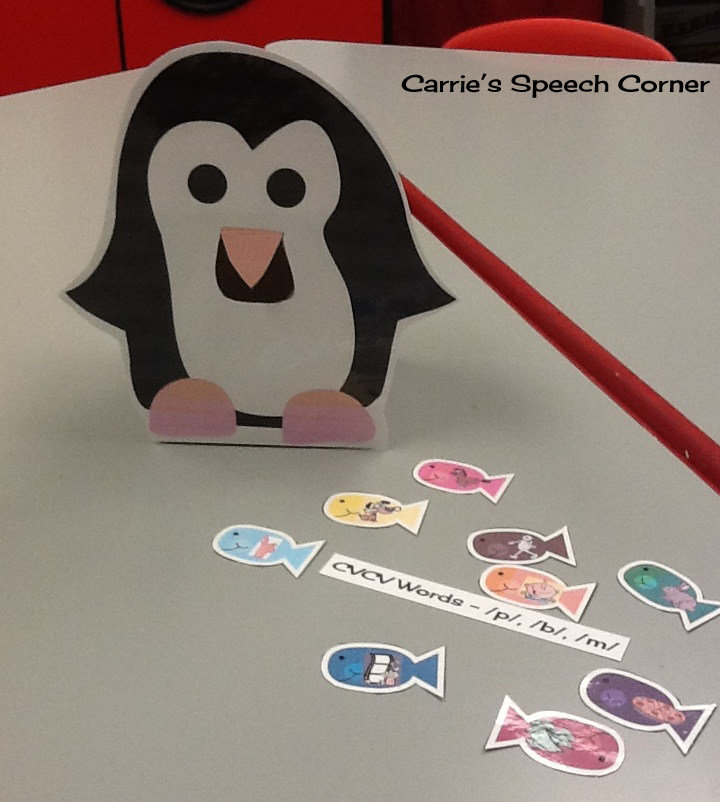
Courtney F. correctly guessed the "Feed the Penguin" series!


If you participated, I hope you had fun!  If not, join me again tomorrow night and we'll do it again!


***These giveaways already happened and winners were announced.  Please do not enter here on the
blog***

Guest Post: Fluency Tips and Tricks {by Maureen of The Speech Bubble}


Thanks so much to Carrie for including me in her 'Bloggy Birthday' celebration! Congrats!   My name is Maureen Wilson M.S., CCC-SLP and  I am a school-based SLP.  I write the blog, The Speech Bubble :)


Today I want to share some tips and resources that I have found to be helpful when working with students who stutter.  Fluency can be a tricky and complicated area. In the schools, opportunities to work with fluency students can be scattered, making it difficult to gain knowledge and experience. Here are some points  I have picked up that have been helpful to me when working with this group.

Does the student already have diagnosis?
Does the student being brought up for fluency concerns already have a diagnosis of stuttering?  If not, that means that you will need to do some screenings or testing. Remember, RTI can be used with fluency students too!  If the student can read, I like to use the 'Rainbow Passage' as a screening tool.  If they cannot read, picture description is a great way to obtain a speech sample.  Make sure you note any disfluencies, the type of disfluency and length of occurrence, as well as % of stuttering.  A good sample should be at least 100 syllables in length and you should aim to get at least 3 samples.

Does the student receive outside speech therapy for stuttering?
If you receive a request to see a student for fluency, check to see if they are currently seeing an outside speech therapist.  If the parent grants consent, touch base with the outside SLP and collaborate on goals and strategies. Find out what has and hasn't worked for the student.

Observe and Ask
Make time to observe the student in different settings.  I know this can be difficult with our schedules but it really can provide lots of useful information. Watch the child's body language and amount of class participation. Do they play with other students? Answer questions?  Ask the student how they feel about their stuttering. I have had student who truly did not care one bit that they stuttered and others who would be on the verge of tears if you asked them a question.  The student's feelings and perceptions are powerful factors in designing their treatment plan.

Secret Signals

Once your student has begun to master their fluency strategies inside the walls of your speech room helping them transition these skills into the classroom is key.  A strategy that my students have had a lot of success with is using a 'secret signal'.  One of my students compared it to having a personal 'Bat Signal', ha.  You, the teacher, and student create a secret signal that the teacher will use when the student needs a reminder to use their fluency strategies in class. A quick tug on the earlobe has been the best one so far.  It is discrete and gets the message conveyed.

So what materials are out there to help you address your student's fluency goals? Lots!  Here are some of my favorites:


For more information and resources about stuttering check out:


I had done a post awhile ago about a friend of mine who has stuttered his entire life. He shared his experiences and advice on the subject, as well as, some video before and after he attended an intensive fluency program. You can check out that post here.

~ Maureen


First of all, Thank you so much Maureen for sharing this wonderful information!   You can find Maureen's blog, The Speech Bubble, on Facebook.  Make sure you check out her Teachers Pay Teachers Store as well for some fantastic materials!

Second, if you have not seen it, you NEED to check out the video that Maureen posted on her blog.  It's simply amazing and truly inspirational!  


Related Posts Plugin for WordPress, Blogger...