Showing posts with label Super Duper. Show all posts

Sunday, January 19, 2014

A Little Final Consonant Deletion Karma

This year the majority of my 3-year old articulation students have a little final consonant deletion going on.  Not surprising, I know.  Well, I've been plugging away at getting them to mark those final consonants and they're doing great!  Next step?  I pulled out the FCD story from Read Aloud Minimal Contrast Stories With Activities from Super Duper.  This one is about a monkey who finds all sorts of strange things in her mailbox.  I got the story printed for my group and grabbed some markers.  And then it occurred to me...Hey! I have a monkey!  I got him with my Talk it, Rock it (formerly Kids Express Train) CDs.  Wait a minute! I also have a mailbox!  (Thanks Target Dollar Spot!)  My kids had a blast making the monkey look in the mailbox for their target words!  


Don't you love it when your therapy plan ends up being even better than you had planned??  Have you ever planned something and had it transform into something even better?


Wednesday, October 23, 2013

Product Review: Pirate Talk by Super Duper

Oh that red box! Who doesn't love coming home to find one of these at their door?


When the nice folks at Super Duper contacted me about reviewing one of their products, I was happy to do so!  First, I'd be foolish to say no to an awesome product from Super Duper (yes I knew it would be awesome before even opening the box!). Second, I love getting new materials for my kids.  Third, I know many of you look to bloggers like me to find how what we really think of products and apps!  Here's what was in the box:


The Details:

Pirate Talk: Receptive & Expressive Language Game.
Created by: Sarah Michaels and the Super Duper Staff.
Grade Level: K-5
Description (from Super Duper's website):  Your students are about to embark on a swashbuckling adventure as they sail the high seas with Pirate Talk, the receptive and expressive language skills game! As students respond to each prompt, they move from island to island on the colorful game board and collect gold coins. The prompts reinforce seven essential communication skills:  Sentence Repetition, Answering Questions, Following Directions, Categorizing, Inferencing, Describing, and Social Skills.
Includes:  Game Board, 150 Color-Coded Receptive and Expressive Language Cards(5 subject areas, 30 cards each), Instruction Sheet, 6 Pirate Player Pieces, 100 Gold Coins, and Electronic Spinner (1–3)


A Closer Look:

My son has learned that a box at the door equals something fun.  So when we came home, he begged me to open this one right away!  We opened the box, took out the game board, and checked out the other items:

Notice M's foot anxiously waiting to play!
I skimmed the directions because I prefer games that allow you to fly by the seat of your pants.  I believe that if the directions are too long and complicated, the kids won't want to play the game.  Am I right?  Anywhoo...you can see that the game comes with basic directions and game variations!  This is great for changing things up and using the same materials for multiple sessions, but in new and exciting ways!


After that, I organized the cards.  I think it's a personality requirement for SLPs to love organization and clearly Super Duper is a company of SLPs! The box has a tray that holds your cards and the cards come color coded and with dividers:


The cards have different scenes on the front.  The scenes depict scenarios from 5 different categories:  activities, community, home, school, and people.  Here's a sample card from the "activities" section:


Super Duper really does have great illustrations, don't they?  On the back of each card are the prompts for each target area: Sentence Repetition, Answering Questions, Following Directions, Categorizing, Inferencing, Describing, and Social Skills. I found that we could use the pictures as conversation starters as well.

Notice that some cards allow children to earn "bonus" coins!

Instead of dice, Pirate Talk comes with an electronic game spinner! How cool is this?!? I love that you only have the option of spinning a 1, 2, or 3 and I may just have to use this with other games as well!  The kids loved pushing a button instead of rolling a game die and NOTHING fell on the floor!! :)


What may just be the best part of this game is that it comes with 100 gold coins! I didn't count them, I'm going to take Super Duper's word for it!  Boys and girls were thrilled to play this game and to earn these shiny coins!


Trying it Out:

My son was in love with the game and didn't really want me to bring it to work.  Once he got over that, I brought it to school and tried it out with my kids.  I used it with kids in Preschool and in Second Grade.  We played the traditional version, nothing fancy.  The kids LOVED it! I loved that I could use it in a mixed group and target different objectives with the same cards!  I did find that with larger groups of kids, we weren't able to "finish" the game by returning our pirates back to their home bases, but none of the kids minded. They were happy to count their coins to find the winner.  If you're wondering, 2nd grade loved it as much as the preschoolers.


Bonus Activity:

My super-observant friend Stephanie was quick to make this observation...There are 100 gold coins. New information suggests aiming for 100 articulation trials/session.  See where I'm going with this?  You can use the coins for motivation in an Articulation Challenge!


I made a quick "bank" out of a butter tub, but how much fun would it be to use a treasure chest piggy bank!?!?


The Take-Away:

Pros:

  • As a receptive/expressive language game, Pirate Talk has it all.  You can look at a picture scene and ask each type of question, in addition to targeting inferencing and pragmatics.
  • Versatility!  The game cards themselves make Pirate Talk versatile, but the adaptability of the game goes beyond that. (See description below)
  • Fun! Who doesn't love a pirate theme?!?
  • The description on the box says that this game is for Grades K-5, but the box itself says that you can use it with Grades K and up or Ages 4-10.  

Cons:

  • I can't think of a single one!


The Bottom Line:
Pirate talk is a fun, engaging addition to your therapy supply closet.  According to the game's description, you can use it to target 7 areas of communication. However, I have found that you can use it for so much more than that!  The game board can be used for an open-ended activity, the spinner can be used to make your game boards (like those from TPT) more fun, and the gold coins can be used to get 100 trials during Articulation Burst therapy!

If you have Pirate Talk, what's your favorite game variation?  If not, what's your favorite product from Super Duper?


Friday, September 27, 2013

Super Duper Speech!

I was contacted recently by the nice folks at Super Duper about reviewing one of their products on the blog.  I was given a list of items to choose from and, not surprisingly, I already owned more than half of them!  While I'm waiting for the product I will be reviewing (you'll have to wait to find out what it is!), I figured I'd share some of my favorites!

I started looking around my room and was surprised at how often I saw the Super Duper logo! (You know, the two kids in the black oval).  So here are some of my favorites (in no particular order)...


Word FLIPS:
I've talked about this product before, but in case you missed it...FLIPS stands for "For Learning Intelligible Production of Speech."  I use this with most of my expressive language/articulation kiddos for 3-5 minutes at the start of just about every session. It's a great warm-up for expressive language/articulation activities. Also, it a good preschool vocabulary building activity! What I didn't mention the first time around is that it's great for kids with apraxia or other motor planning difficulties.  The book is divided into three sections and each section is printed with CV words, divided by sound (e.g., bee, boo, bye...tie, tea, toe...shoe, show, she, etc.).  You can make any combination of words you'd like.  My first copy of this book was so well loved that I ended up getting a second!  Now I have the opportunity to have kids sequence up to 6 CV sequences!


Lids 'n Lizards:
I bought this game some time last year and it has instantly become a favorite (of mine and of the students!).  With my little kids, I typically keep the magnetic pictures on top of the lids and have kids either name the picture, tell me about the picture, find a member of a specified category, or choose a picture to answer a WH question (e.g., What can you use to heat up your food?).  They absolutely LOVE finding the lizards!  I love that you can target /l/ in the middle of a language lesson!  I also love that you can grab other little animals at the dollar store (frogs, dinosaurs, etc.) to coordinate the game with classroom themes!  In addition, there is a list of game variations printed on the inside cover, making this game VERY versatile!


Grammar Gumballs:
This is another new-to-me product that I got at the end of the year.  I love that I can address multiple targets in the same session and the kids love the reinforcement of collecting bubble gum.  I've even used the game board within articulation sessions as reinforcement.


Fun Decks:
I have a bunch of these.  I store them in a drawer-box that is designed to hold CDs.  I found the box at an odd-lot type store and the fun decks fit perfectly! Also, did you know that many of the fun decks are available as apps?

(I couldn't find Voice Choice! on the website so I'm not sure if it's still available)

Voice Materials:
Last year I got my first ever student (pediatric) with a voice disorder.  I needed help (and materials) FAST! I ended up getting Voice Choice, Voice Adventures, and Martha Mouse & Baby Bear.  They have been a HUGE help for this kiddo!


Chipper Chats (etc.):
Whenever anyone asks me what my "Must Have" therapy materials are, I always answer with Artic Chipper Chat and WH Chipper Chat!  They are so versatile and can be used in many different ways!  I like to use WH Chipper Chat to take baseline data for answering questions!  Auditory Adventures is another great product for kids with comprehension and processing difficulty and Basic Concepts is wonderful for my youngest preschoolers!


These are another "Must Have!" If you're a new SLP, you need at least one of these (preferably one that comes with a CD!!).  I STILL use these books to make my own artic cards!!  In fact, I wrote a post about that, which you can read HERE.


Category Cut-Ups:
Last, I shared with you yesterday about how I introduced the EET to my preschoolers (you can find that HERE if you missed it).  After I wrote the post, I had an older student.  To introduce the concept of "groups" or "categories," I made some copies from this book, then we sorted the items (I didn't give him a whole lot of instruction other than to "make groups...as many as you need").  We used dry erase markers to draw circles on my table and give names to our groups!


And there you have some of my favorite things from Super Duper!  Now, while I'm waiting for the red box to show up at my door, Super Duper has given my fabulous readers (yes, that's YOU!) a special code that will earn you 30% off web orders!  When you check out enter the following code to receive the discount:

DHRMKSP8

Happy Shopping!  

PS, What's your favorite Super Duper product???


Tuesday, May 28, 2013

App Review and Giveaway: Kangaroo Island Photo Classifying

Recently I was contacted by the good folks at Super Duper, Inc. about reviewing one of their new apps, Kangaroo Island Photo Classifying.  I have a few of the Super Duper Fun Deck apps, but this app is different as it is more interactive, and I was very excited to give it a try!

Getting Started:

This is the home screen of the app:


As you can see, there are six different activities included in the app:
  • Class-a-Roo
  • Picking Parrot
  • Skink Ball
  • Turtle River
  • Koala Canvas
  • Seal Search

If you tap on the lighthouse, you can see a list of the categories that this app offers, as well as all of the individual members of those categories.  This is especially helpful if you wish to pre-teach members of a given category.


There are three icons along the bottom of the home screen as well.  Tapping the first, the "Share" icon, will allow you to email Super Duper and view their Facebook and Twitter pages.  Tapping the center "Thumb up" button, will allow you to report a bug, review the app, or make a suggestion to the app developers.  Finally, tapping the "i" or "information" button, will show you a description of Kangaroo Island (see below).


Playing the Games:

To collect data, you must first add a player.  Also, it should be noted that only one player can play at a time.  To add a player, tap the Tiki labeled "Player."  Next, tap "add player."  You can enter the player's name and select the categories you wish to target.  It should be noted that, although you are able to choose more than five categories, no more than five will be used during any given game activity.  You can also choose to use pictures or text for the category items, and whether or not you want the app to say the category and item names.


This "Player screen" is where you can view data from previous sessions.  As you can see, I entered a player named "Any" to be used with groups of students and for students who may not use the app frequently.  I figured that this way, I could jot down the accuracy level on paper rather than store the data in-app.  Under the graph, you can see the different animal pictures.  If you tap a specific picture (e.g., the kangaroo), you can see data for that specific activity only (e.g., "Class-a-roo").  Tapping the last icon will show combined data for all the different activities.  You can also email or print your data ("share" and "print" icons just above the graph).


Once you've set up your students, you're ready to play the games.  Here's a breakdown:

Class-a-Roo:

In this activity, the student is prompted to help Sally the Kangaroo find her friends by choosing the correct item and placing it in her pouch.  Sally hops across the screen and a thought bubble appears with the target category.  Players then have to choose the correct coconut and either tap it or drag it to her pouch.  If incorrect, the coconut will rise up off of the screen.


After a predetermined number of correct responses, Sally will meet a different friend:


Picking Parrot:

In this activity, the student is told that Paul the Parrot is hungry and they can feed him a snack after sorting the items into categories.  The categories are marked on the sand and the students sort the category items (circles) by dragging and dropping to the correct location. If incorrect, the circle returns to the top line-up.


After a student has sorted 2 items into each category, they are able to feed a snack to Paul:


Skink Ball:

Where I live, we call this game Skee Ball.  Regardless of the name, the kids love this one!  Basically, the little skink (I looked it up, a skink is a type of lizard!) holds a ball for you to roll down the correct lane.  When correct, the lane lights up.  When incorrect a buzzer sounds.


After a while, the student will earn a ticket from the machine:


Then they trade in their ticket for a toy on the shelf!  From what I've experienced, the more correct items you get, the more toy options you have.


Seal Search:

For this activity, the student is prompted to find Cindy the Seal by choosing an item that does not belong with the others.  In this example, "pizza" would be the correct response because it is not a color like the others.  If the student is correct, the puzzle piece will remove to reveal a portion of the background.  If incorrect, the items in the circles fade and the puzzle piece remains.


When a student gets all four correct, they find the seal!  The backgrounds will change for subsequent trials.


What I love about this game is that you can easily include targets such as:  describing pictures, using prepositions (on the beach, under the water), answering WHERE questions, etc.

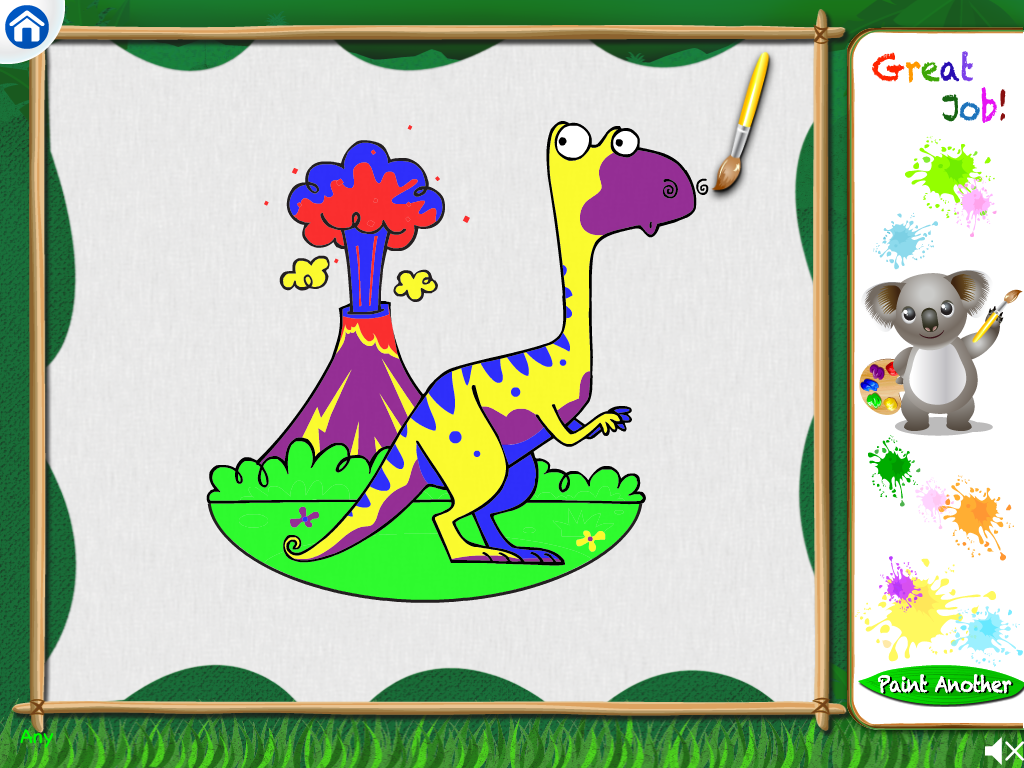
Koala Canvas:


In this activity, students can paint a picture with Cole the Koala.  First, they will need to choose a picture an a color palette.


Next, they dip the paintbrush into a color (category) and tap an item that belongs to that category.  As they tap items, portions of the picture are colored.  You do need to return the paintbrush to the paint each time you tap an item.  For example, you cannot tap "colors" then bring your brush to both "orange" and "blue."  If a student is incorrect, they are told why they are incorrect (e.g., "Cow goes with animals.").


Here's the finished picture:


Turtle River:

For this activity, the student is told that the turtles need help finding their home and that students should place the turtles on the correct island.  The turtles swim between the islands and, although they move at an acceptable speed for many people using this app, I found that they were a bit too fast for some of my students.  If a student is correct, the turtle will go to the island.  If incorrect, they hear "Ooops, try again" while the turtle returns to the water.


After the student finishes, an animated turtle is seen walking on the island toward a cluster of eggs, one of which hatches.


What I like about this app:

  • The variety of games.  With this game you get six different activities, all targeting classification/categorization.  I also like that in Seal Search, category exclusion is targeted.
  • The graphics and animations make this game motivating and entertaining to students.
  • The amount/content of categories included.  I like that this app includes academic categories (e.g., upper case letters, lower case letters, numbers, etc.).  We often see students who have difficulty recognizing the difference between letters/numbers and this would be a great app to reinforce that concept.
  • The ability to target inclusion/exclusion within the same app.
  • There is a large number of items within the given categories.
  • I also love the interactive element.  This app plays like a game, which is always more motivating to students than apps that do not have a game-play component.  

Changes I would like to see in an update:


  • I would love to be able to play with more than one player at a time.  I don't think this is a real "negative" as far as playing the game.  I created a profile to be used only for groups.  However, when you are playing with a group, you can't effectively use the data collection features.
  • Again, for some of my students, the turtles in "Turtle River" moved a bit too quickly.  I would love to see an added setting with maybe 2 or 3 speed options.

The Bottom Line:
No doubt Super Duper is your go-to location for speech-language therapy materials "hard goods."  I was excited when they branched out into the app world with their Fun Deck apps.  Now, Super Duper has really hit the ball out of the park with the addition of more interactive apps, Kangaroo Island Photo Classifying included.  This app has been frequently requested since I added it to my therapy sessions.  It makes working on category inclusion and exclusion more fun and interesting.  If you find yourself working on classifying/categorization, then this app is a must-have!

Kangaroo Island Photo Classifying is on sale for $9.99 (in iTunes) during the month of May for BHSM.  As of June 1, it returns to its regular price of $12.99.  However, Super Duper was kind enough to offer a code for me to give away to one lucky reader!  Enter to win using the Rafflecopter below.

Disclaimer:  Super Duper provided the codes for this app review and giveaway. However, the opinions expressed in this review are mine alone.


Related Posts Plugin for WordPress, Blogger...